
MCC vs Distribution Board: What Is the Difference?
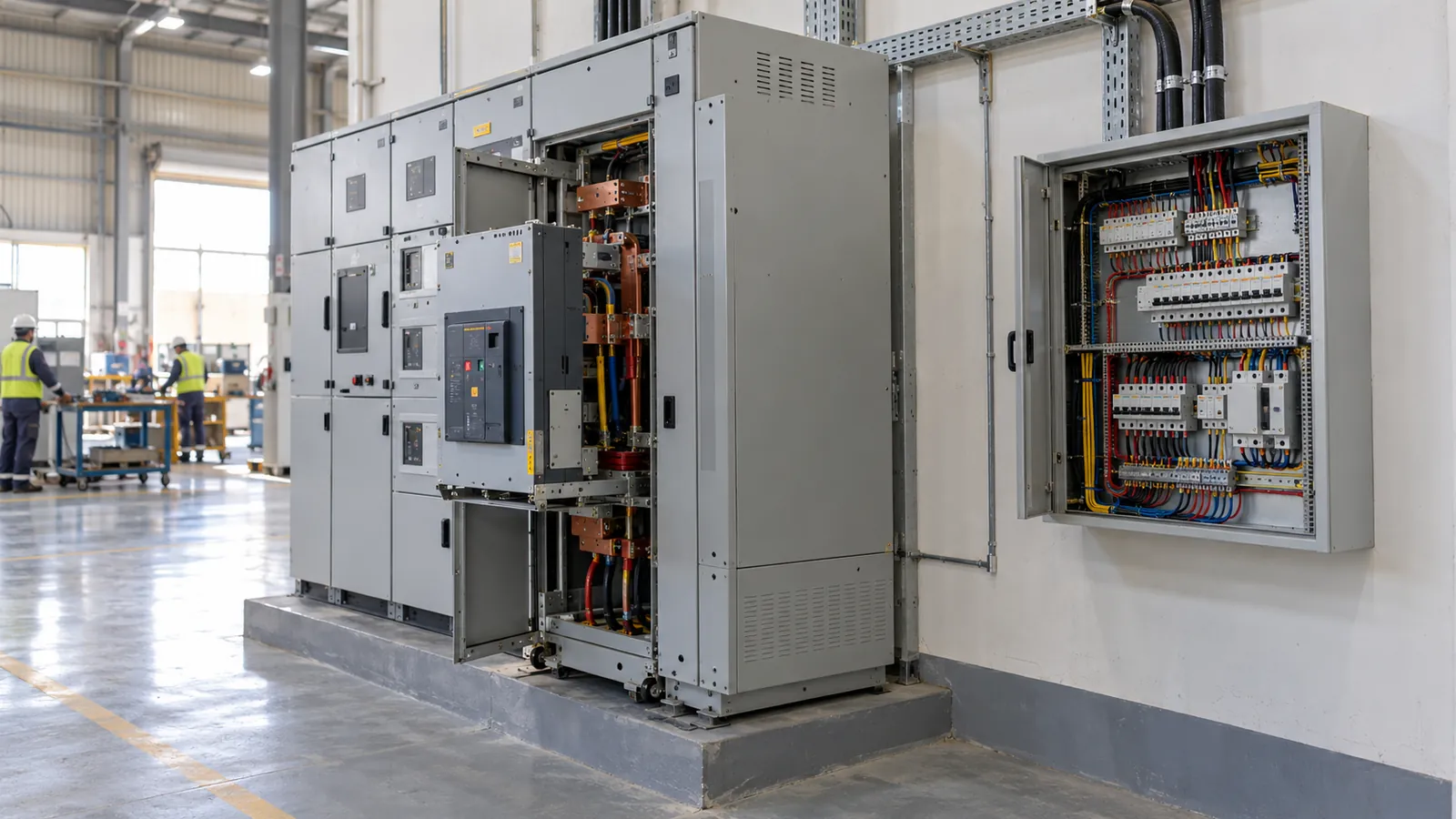
The MCC vs distribution board difference is purpose. A distribution board splits incoming power into protected circuits for lighting, sockets and small loads. A motor control centre, or MCC, starts, protects and controls motors, with starters, overloads and control wiring in each unit. If the load is a motor, you usually want an MCC.
What you receive: send your load list or single-line diagram, and your quotation within one working day names the right panel type, ratings, form of separation and lead time. Request a quotation
By Eng. Babu Parkash, Panel Engineering, Saudi Control Panels Company. Published October 2026.
What is an MCC panel, in full?
MCC stands for motor control centre. It is a floor-standing assembly of starter units, grouped on a common busbar, that controls many motors from one place. Each unit holds the short-circuit protection, a contactor or other starter, overload protection and the control circuit for one motor or drive.
A distribution board, usually written DB, is an assembly that feeds outgoing circuits through circuit breakers or fuses. A main distribution board (MDB) takes the supply from the transformer or generator and feeds sub-boards. Sub-distribution boards (SMDB) and final distribution boards pass it on towards the load.
The two are not rivals. Most industrial sites have both, linked by the same single-line diagram.
MCC vs distribution board: how do they differ in practice?
| Point | MCC | Distribution board |
|---|---|---|
| Main job | Start, protect and control motors | Distribute and protect circuits |
| Typical load | Pumps, fans, compressors, conveyors | Lighting, sockets, HVAC feeders, sub-boards |
| Units | Starters: DOL, star-delta, soft starter, VFD | Breaker feeders, MCCBs, MCBs, isolators |
| Control wiring | Heavy: interlocks, start, stop, status | Light: trip signals and metering |
| Unit construction | Often withdrawable, with plug-in units | Usually fixed |
| Separation | Form 3b or 4b common | Form 1 to 2b common |
| Typical ratings in our range | Up to 4,000 A busbar | Up to 800 A for distribution boards |
| Typical lead time | 4 to 6 weeks | 1 to 2 weeks |
The ratings and lead times above are our current ranges. Larger distribution gear sits in the MDB category, which reaches higher ratings and longer lead times, covered on the LV switchboards and MDB page.
Which panel does your load need?
Decide by asking what happens at the load end.
- Does the load rotate? Motors need overload protection, a starter and often a stop circuit. That belongs to an MCC unit.
- Does the load need to start in a controlled way? Star-delta, soft starter or variable frequency drive units suit large motors. Direct-on-line suits small ones.
- Is the load a feeder to other boards? Choose a distribution board or MDB.
- Will anyone isolate and work on it with the plant live? Withdrawable MCC units and Form 4 separation allow it. Fixed units usually do not.
- Will the motor need speed control? A VFD section in the MCC, or a stand-alone VFD panel, adds cooling and harmonic considerations.
If you answer yes to more than one, you need both panels. That is normal.
Worked example: a small pump house
Worked example: the figures are made up to show how the split works. A pump house has two 75 kW duty-standby pumps, four 22 kW process pumps, lighting and small power at 380 V, 60 Hz.
| Load | Quantity | Approx. full-load current each | Starter | Panel |
|---|---|---|---|---|
| 75 kW pump | 2 | 135 A | Soft starter | MCC |
| 22 kW pump | 4 | 40 A | DOL | MCC |
| Lighting and sockets | 1 group | 60 A | MCB feeders | DB |
| Building HVAC | 1 | 80 A | MCCB feeder | DB |
The motor currents add to roughly 2 × 135 + 4 × 40 = 430 A when all run. The DB loads add 140 A. The incoming supply therefore feeds a 600 A MDB with two outgoing feeders: one to a six-unit MCC, one to a distribution board. The MCC takes the motors, which brings the starter, overload and control wiring. The DB takes the balance of the load.
The design saves on both sides. Putting everything in an MCC pays for withdrawable units where lighting needs only a breaker. Putting everything in a DB means every motor needs a separate starter cabinet beside it.
Can a distribution board feed motors?
Yes, for small fixed loads. A distribution board can carry a feeder to a motor starter that is mounted elsewhere. It cannot give you the grouped starters, the interlocking and the withdrawable maintenance that an MCC provides. Beyond a handful of motors, an MCC usually costs less to maintain. In an MCC vs distribution board decision, count the motors first: below three or four small ones a starter feeder from the DB can do, and above that the grouped starters, common busbar and withdrawable units start to pay back through shorter outages and easier fault-finding. Also count the control signals. Each motor that needs remote start, run feedback or an interlock adds control wiring, and that wiring is easier to inspect and test when it sits in one MCC section than when it is spread across separate starter boxes.
Read more about starter types and sections on the MCC panels page, and about standard sizes on the distribution boards page.
Questions about MCC and distribution boards
What is the full form of MCC panel in electrical?
MCC stands for motor control centre. It is a panel that groups motor starters on a common busbar so that many motors can be started, protected and controlled from one place. Each starter sits in its own unit, often a withdrawable drawer.
Is an MCC the same as a switchboard?
They are related but different. A switchboard distributes power from a source to downstream boards and loads. An MCC is a special kind of switchboard built to control motors. Both are LV assemblies and follow IEC 61439, but their contents and uses differ.
Can I use an MCC as a distribution board?
You can feed non-motor loads from an MCC, but it is rarely efficient. MCC units carry starters and control wiring you will not use. For lighting and small power, a distribution board costs less and builds faster.
How do MDB and MCC work together?
The MDB receives the supply and feeds downstream boards. One outgoing feeder goes to the MCC, others go to sub-distribution boards. Protection is coordinated so a fault at a motor starter trips locally, not at the incomer.
How long does each take to build?
A distribution board typically takes one to two weeks, and an MCC four to six weeks, counted from approved drawings. Quantity, withdrawable units, VFD sections and the length of the FAT extend the time.
Weighing MCC vs distribution board for your site? Send your load list and we will answer in a quotation within one working day, with the panel split, ratings and lead time for each.