
Form 4 Switchboard vs Form 2 and Form 3: Which to Specify
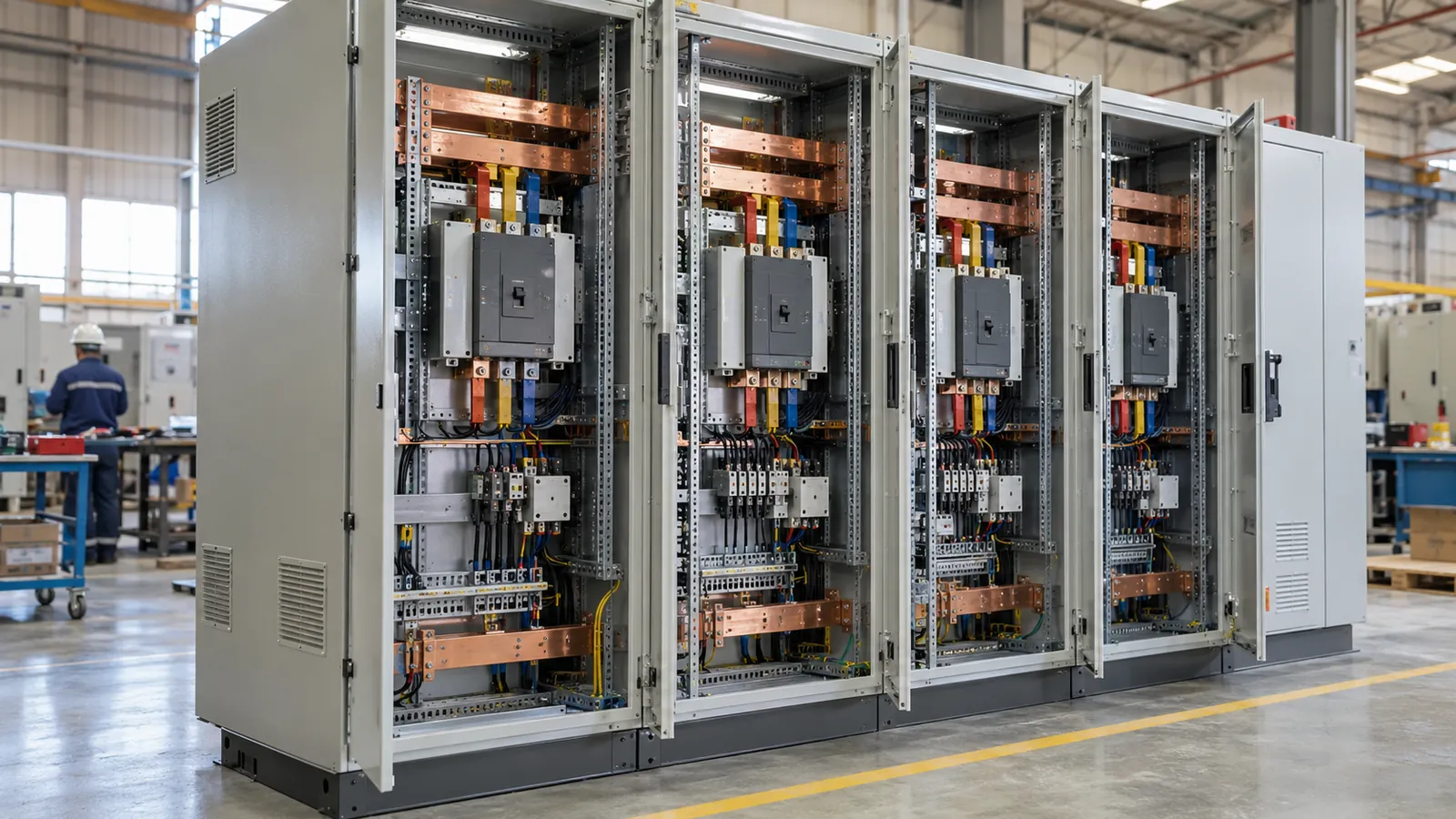
A Form 4 switchboard separates the busbars, every functional unit and the outgoing terminals of each unit from one another, so one feeder can be worked on while the rest stay live. Form 2 and Form 3 give less separation at lower cost. Choose the form by how you will maintain the board.
What you receive: send your single-line diagram and maintenance needs, and your quotation within one working day names the form of separation, ratings, lead time and FAT. Request a quotation
By Eng. Babu Parkash, Panel Engineering, Saudi Control Panels Company. Published October 2026.
What does the form of separation mean?
The form of separation describes how an assembly is divided inside by barriers or partitions. IEC 61439-2 uses it to describe how well one part of the board is shielded from another. It affects safety during work and the damage a fault can do.
A switchboard has three internal parts to separate: the busbars, the functional units (such as a breaker feeder) and the terminals where outgoing cables connect. The form tells you which of these are walled off from the others. The standard names the options Form 1, Form 2a, 2b, Form 3a, 3b and Form 4a, 4b.
Separation is not the same as the IP rating of the enclosure. IP describes protection against solids and water at the outer shell. Form describes the arrangement inside.
How do Form 1, 2, 3 and 4 compare?
| Form | What is separated | Typical use |
|---|---|---|
| Form 1 | Nothing inside the enclosure | Small, simple boards where a total shutdown for work is acceptable |
| Form 2a | Busbars from functional units; terminals not separated from busbars | Light industrial boards with lower continuity needs |
| Form 2b | As 2a, plus terminals for external conductors separated from busbars | Boards where cable work should not expose the busbars |
| Form 3a | Busbars from units, units from each other; terminals not separated from busbars | Boards that need unit-to-unit separation |
| Form 3b | As 3a, plus terminals separated from busbars | Boards with maintenance on single feeders |
| Form 4a | As 3b, with each unit's terminals separated from other units' terminals, in the same compartment as the unit | Boards where one feeder must be fully safe to open |
| Form 4b | As 4a, with the terminals in their own enclosed compartment | Critical boards, high availability, frequent cable work |
Each step up adds sheet-steel barriers, extra compartments and width. The extra cost buys a safer maintenance window and a more contained fault.
When is a Form 4 switchboard worth specifying?
Specify this form where taking the whole board out of service is expensive or hard to arrange. Four situations are typical:
- Continuous process. A shutdown of the board stops lines that cannot be stopped without a planned outage.
- Frequent cable changes. Plants that add or move feeders regularly need terminals they can reach safely.
- Withdrawable units. MCC and draw-out feeders suit Form 3b or 4b because compartments are already defined.
- High fault level. Barriers contain the effects of an internal arc to one compartment, which limits damage.
For standard office-type or utility distribution, Form 2b is usually sufficient and quicker to build. Where the end client's standards name a form, that requirement wins.
Worked example: eight feeders, one maintenance day
Worked example: the figures here are made up to show the trade-off. An MDB feeds eight process lines. Once a year each feeder needs a cable inspection and termination re-torque, taking a half-day. The plant loses output on any line that is dead.
| Option | Work on one feeder requires | Line-hours lost for one feeder | Eight feeders, one year |
|---|---|---|---|
| Form 2b | Whole board isolated | 8 lines × 4 hours = 32 | 8 × 32 = 256 |
| Form 4b | Only that feeder isolated | 1 line × 4 hours = 4 | 8 × 4 = 32 |
The Form 4b version avoids 224 line-hours of lost production a year, in this example. If one line-hour is worth more than the extra build cost divided by 224, Form 4b pays back inside one year. If your lines are not production-critical, Form 2b is the right and cheaper answer. Repeat the sum with your own figures.
What affects the choice besides cost?
Four points deserve attention in the specification.
- Space. Higher forms add compartments. Check that the switch room can take the extra width and that front or rear access suits the layout.
- Ratings. Separation reduces the free air around components. Temperature-rise performance must stay inside the verified limits.
- Standards. The form is part of the design verification under IEC 61439, so any change after approval goes back to the designer.
- Testing. The routine verification and factory test confirm the barriers, shutters and compartments exist as drawn. See panel FAT and testing.
Our LV switchboards are built in Form 1 to Form 4b, up to 6,300 A at 380–415 V, 60 Hz, with a typical lead time of three to five weeks. The full range is described on the LV switchboards and MDB page. MCC sections have their own separation options, set out on the MCC panels page. If the form is still open, a design review before the build avoids rework; we cover that in panel design and drawings.
Questions about forms of separation
What is a Form 4 switchboard?
This arrangement is an LV assembly in which the busbars, each functional unit and each unit's outgoing terminals are separated by barriers or partitions. It allows work on one feeder without exposing live parts in the others, and it comes as Form 4a or Form 4b.
What is the difference between Form 4a and Form 4b?
In Form 4a the terminals for outgoing conductors sit in the same compartment as their functional unit. In Form 4b they sit in their own enclosed compartment, separated from that unit. Form 4b gives more working room and safety for cable terminations.
Is Form 3b enough for an MCC?
Often, yes. Form 3b separates the busbars, the units and the terminals, and suits many motor control centres. The higher form is chosen where terminal work must happen with other units fully live, or where the client's standard demands it.
Does a higher form mean a higher short-circuit rating?
The two are independent. The form describes internal separation. The short-circuit rating comes from the busbar design, the supports and the protective devices, as verified under IEC 61439. A Form 4b board can carry a lower fault rating than a Form 2b board.
How much longer does Form 4 take to build?
Extra compartments add some assembly time, but the main driver is quantity and ratings. Our LV switchboards typically take three to five weeks from approved drawings, and your quotation will state the date for your configuration.
Need a Form 4 switchboard specified or priced? Send your single-line diagram and the maintenance routine you expect, and we will return the form of separation, ratings and lead time within one working day.